
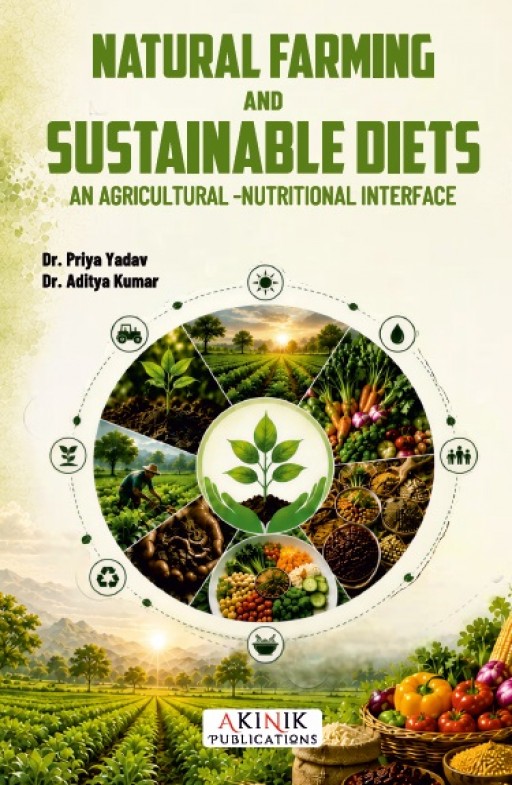
| Editor(s) | : | Dr. Priya Yadav and Dr. Aditya Kumar |
| Paperback ISBN | : | 978-93-7150-322-8 |
| Ebook ISBN | : | 978-93-7150-696-0 |
| Publisher | : | AkiNik Publications |
| Language | : | English |
| Pages | : | 351 |
| Publication Year | : | 2026 |
| Publication Date | : | 09/03/2026 |
| Binding | : | Paperback |
| DOI | : | https://doi.org/10.22271/ed.book.3709 |


Wonderfully written, giving a insights of agriculture, nutrition in a very descriptive form really helpful in knowing Agriculture and it's Nutrition prospective
Natural Farming and Sustainable Diets is an absolute masterpiece that brilliantly bridges agro-ecology and medical science by proving that human metabolic wellness begins in the soil. This groundbreaking and highly commendable book masterfully demonstrates how chemical-free cultivation protects microbial networks, which naturally maximizes food density and optimizes our gut health. By championing climate-resilient heritage crops, this outstanding text provides an elegant, forward-thinking solution to global malnutrition and chronic diseases. It is an indispensable, visionary guide that acts as the ultimate blueprint for the future of preventive medicine.
This book provides a comprehensive understanding of natural farming and its role in sustainable nutrition. The chapters are well-written and supported by relevant scientific concepts. A must-read for anyone interested in sustainable agriculture.
A valuable contribution to the fields of agriculture and nutrition. The book clearly explains the relationship between natural farming and sustainable diets with practical insights and evidence-based information. Highly recommended for students, researchers, and professionals. Thank you!
Incredible work done by Dr Aditya and the team. Wishing you all the very best for the future.
Natural Farming and Sustainable Diets is an informative and well-written book. It provides valuable insights into natural farming and sustainable diets in a simple and easy-to-understand manner. A highly recommended resource for students and researchers.