
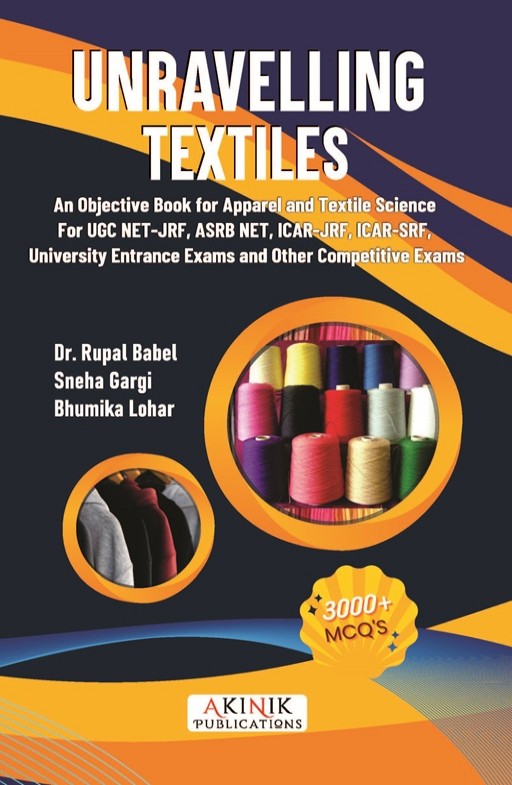
| Author(s) | : | Rupal Babel, Sneha Gargi and Bhumika Lohar |
| Paperback ISBN | : | 978-93-7150-626-7 |
| Ebook ISBN | : | 978-93-7150-273-3 |
| Publisher | : | AkiNik Publications |
| Language | : | English |
| Pages | : | 554 |
| Publication Year | : | 2025 |
| Publication Date | : | 10/11/2025 |
| Binding | : | Paperback |
| DOI | : | https://doi.org/10.22271/ed.book.3543 |


"Unravelling Textiles" is an exhaustive guide designed for students, educators, and professionals pursuing careers in Apparel and Textile Science. The book covers a wide range of topics essential for understanding the textile industry, from the basics of textile science and fabric care to the advanced techniques in garment construction, fashion, and textile ecology. The content is presented in an objective-format, making it highly useful for candidates preparing for competitive exams such as UGC NET-JRF, ICAR JRF/SRF, ASRB NET, and various university entrance tests. It includes multiple-choice questions, match-the-following, sequencing, and assertion-reasoning types of questions, all with answer keys, allowing students to engage in active learning and self-assessment.
Key topics covered include the fundamentals of fabric construction, dyeing and printing, textile finishes, traditional textiles, garment designing, and modern advancements in textiles such as sustainable fabrics and technical textiles. The book also explores critical aspects like textile ecology, CAD (Computer-Aided Design), and industrial management, offering a comprehensive understanding of the textile industry's impact on both fashion and the environment. Whether you're preparing for academic exams or pursuing professional growth, "Unravelling Textiles" provides a well-structured, thorough foundation for mastering this multidisciplinary field. The book’s emphasis on clarity, comprehensive content, and exam-oriented structure makes it an invaluable resource for all learners in this field.
The research component is highly commendable, showcasing an advanced understanding of disciplinary data collection techniques. The author's precision in data contextualization and interpretation provides an unassailable foundation for the theoretical claims. A technically sophisticated and valuable scholarly contribution.