
| Author(s) | : | Arshi Malik |
| Paperback ISBN | : | 978-93-7150-844-5 |
| Ebook ISBN | : | 978-93-7150-521-5 |
| Publisher | : | AkiNik Publications |
| Language | : | English |
| Pages | : | 263 |
| Publication Year | : | 2025 |
| Publication Date | : | 02/10/2025 |
| Binding | : | Paperback |
| DOI | : | https://doi.org/10.22271/ed.book.3542 |
| Amazon | : |  |


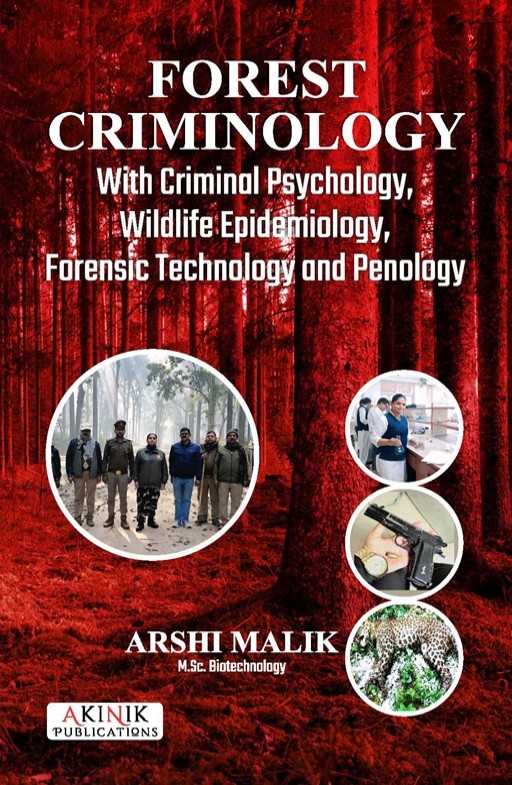
The field of Forest Criminology encompasses the study of criminal activities that affect forest ecosystems, including illegal logging, wildlife trafficking, and land encroachment. It integrates diverse disciplines such as criminology, law, biology, psychology, and forensic science to analyze and combat forest crimes. The book "Forest Criminology with Criminal Psychology, Wildlife Epidemiology, Forensic Technology, and Penology" provides a comprehensive exploration of this evolving field. It examines the causes and patterns of forest crimes, highlights the role of criminal psychology in understanding the motives of offenders, and discusses the application of modern forensic technologies to investigate and prevent forest-related offenses.
The work also delves into wildlife epidemiology, emphasizing the link between forest crimes and the spread of zoonotic diseases, as well as the importance of maintaining the health of forest ecosystems. A significant portion of the book is dedicated to the legal and judicial aspects, outlining the various acts, rules, and regulations governing forest crimes, as well as the judicial proceedings involved in prosecuting offenders. The book also covers the role of forest crime control organizations, detailing their structure and responsibilities in combating environmental crimes.
By offering theoretical insights, case studies, and practical strategies, the book aims to equip readers with the tools needed to understand and mitigate the impacts of forest crimes on biodiversity and ecosystem health.
Knowledge is power and information is the key to knowledge, which this book provides for, in the domain of wildlife and nature. No doubt, this book iwould prove to be especially useful for students and nature lovers. The definition and terminologies are well collated for references and for usages in the realm of wildlife Management and Wildlife offence ckbtrol. I wish the author blessings and a bright future.
“Forest Crime” is a very interesting and thought-provoking book. It highlights illegal activities happening in forests and their serious impact on wildlife and nature. The author has explained the importance of protecting forests in a clear and engaging way. The story feels realistic and keeps the reader interested throughout. This book creates awareness about environmental responsibility. The language is simple and easy to understand. Each chapter offers something new to learn. It has a good mix of suspense and information. This book is especially useful for students and nature lovers. Overall, it is an informative and inspiring book that
An expertly organized text where clarity and precision in presentation are prioritized. The author's commitment to unambiguous language ensures that the sophisticated theoretical claims are easily absorbed by the academic audience.